Key Takeaways:
- Compatibility trumps brand. The thermostat that works best is the one that matches your specific HVAC system — not the most popular or most expensive. A J.D. Power study found 28% of returns were due to system mismatch alone.
- Check your wiring first. The terminal letters behind your existing thermostat (R, W, Y, G, O/B) tell you everything you need to know before buying. Run a free compatibility checker before spending a dollar.
- The C-wire is the most common obstacle. Over 26 million U.S. homes built before 1990 lack one. Ecobee’s included Power Extender Kit is the most reliable fix; Nest’s power-stealing workaround can cause issues with anything beyond a basic single-stage furnace.
- Real savings are more modest than advertised. ENERGY STAR’s field data puts average annual savings at around 8%, or $50–$100 — not the 23–26% manufacturers tout. The biggest gains come from replacing a poorly managed manual thermostat, not upgrading from an already well-programmed one.
- Utility rebates can cut your payback period in half. Most homeowners ignore them, but many utilities offer $50–$100 upfront rebates plus $20–$60 annually in demand-response credits — potentially offsetting 30–50% of the purchase price.
The answer to “which smart thermostat should I buy?” isn’t Nest, Ecobee, or Honeywell. It’s whichever one is engineered to speak fluently with your specific HVAC system. Buy the wrong device and you’ll face erratic temperature swings, fried control boards, or — at best — a thermostat that costs $250 and behaves like a $30 programmable one. Get the match right, and the U.S. Department of Energy estimates you could trim heating and cooling costs by up to 10–15% annually, a meaningful figure considering that climate control already accounts for nearly half of the average American home’s energy bill.
This article breaks down exactly how to assess your system, which smart thermostats excel with which HVAC configurations, and what the data says about real-world energy savings.
Why HVAC Compatibility Is the Only Spec That Truly Matters
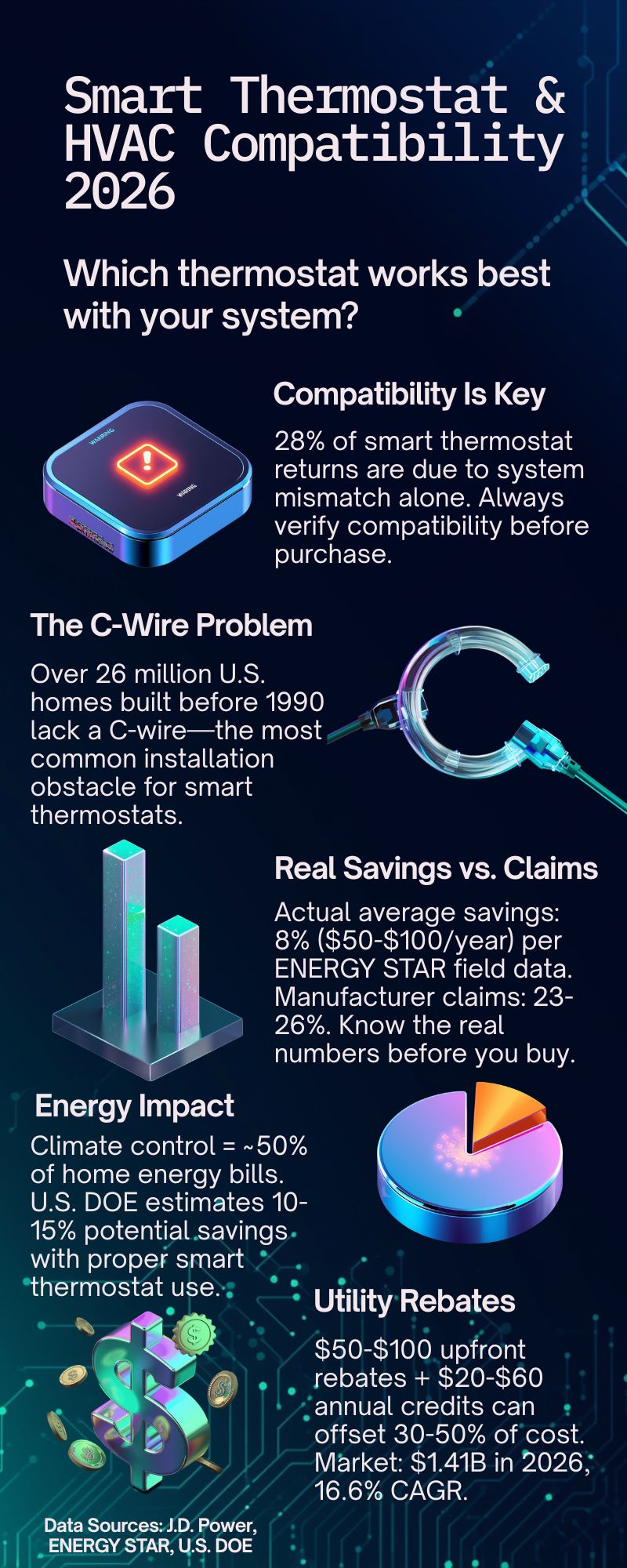
Before you scroll through touchscreen sizes or debate whether you need a built-in Alexa speaker, compatibility is the non-negotiable foundation. The U.S. smart thermostat market is on track to reach $1.41 billion in 2026, growing at a 16.6% CAGR through 2034 — yet that expansion is still being held back by one persistent problem: incompatibility with legacy and non-standard heating and cooling systems. A J.D. Power study found that 28% of dissatisfied smart thermostat owners cited installation complexity or system mismatch as the primary reason for returning their purchase — a sobering statistic that underscores why compatibility must come before aesthetics or brand loyalty.
There are two variables that determine whether any smart thermostat will work in your home:
- Voltage: Most U.S. residential systems run on 24-volt low-voltage controls, and virtually every modern smart thermostat is designed for exactly this. High-voltage systems — such as 120V or 240V electric baseboard heaters — are the major exception. Plugging a 24V device into a line-voltage system will destroy it instantly.
- Wiring configuration: Smart thermostats need a continuous power supply, typically delivered via a “C-wire” (common wire) that provides a constant 24V current. Forced-air furnaces built after the mid-1990s almost always have an extra conductor tucked behind the wall that can serve as a C-wire. Older homes, boilers, and many ductless mini-split systems frequently lack one.
The good news: every major thermostat brand — Nest, Ecobee, Honeywell, Emerson — offers a free online compatibility checker that cross-references thousands of system models, including dual-fuel heat pumps and variable-speed condensers. Spending two minutes with one of these tools can prevent a very expensive mistake.
Step One: Identify Your HVAC System Type
Remove the cover from your existing thermostat and photograph the wiring terminals before you buy anything. The letters you see tell a precise story:
- R and W only: Basic single-stage furnace. The simplest possible configuration — compatible with virtually every smart thermostat on the market.
- R, W, Y, and G: A furnace paired with central air conditioning. Still broadly compatible, but check for a C-wire.
- O/B terminal: The unmistakable sign of a heat pump. The O/B wire controls the reversing valve that switches the system between heating and cooling modes — a critical function that not all thermostats handle correctly.
- Y2 or W2 terminals: Indicate a two-stage system, where the compressor or furnace operates at different capacities depending on load. These require a thermostat with multi-stage support.
HVAC systems that use proprietary communication protocols — such as Trane’s “ComfortLink” or Carrier’s “Infinity” platform — operate on a four-wire data bus that standard smart thermostats cannot communicate with. Zoned ductwork adds another layer of complexity: replacing one thermostat in a master-slave chain can disrupt the entire network. If your system falls into either of these categories, a licensed HVAC technician should assess your options before you buy anything.
The C-Wire Problem (and How Each Brand Solves It)
The C-wire is the single most common installation obstacle. Homes built before 1990 — over 26 million according to the National Association of Home Builders — often lack the electrical infrastructure to support a modern smart thermostat without professional rewiring.
Each of the top three brands approaches this differently:
- Google Nest (4th Gen) uses a “power stealing” method in homes without a C-wire, borrowing current from other terminals. This works in the majority of cases, but can cause problems with certain HVAC systems, including triggering short-cycling or interfering with blower speeds. HVAC professionals widely advise against it for anything other than standard single-stage systems.
- Ecobee includes a Power Extender Kit (PEK) in the box with most of its models. The PEK installs at the furnace or air handler, not the thermostat, and effectively creates a C-wire from existing wiring — a more reliable and system-safe solution than power stealing.
- Honeywell Home T9 ships with a C-wire adapter and is widely noted for its contractor-friendly installation, which has made it a default choice among professional HVAC installers for decades.
If your home lacks a C-wire, you have three legitimate options: fish a new wire through the wall (the cleanest solution, but labor-intensive), use a manufacturer-supplied power extender kit, or add a plug-in 24V transformer if an outlet is nearby. The “borrow-a-wire” workarounds circulating on home improvement forums can disable blower speeds or compressor staging and should be avoided.
Smart Thermostat Matchups by HVAC System Type
Standard Gas or Electric Furnace (Single-Stage)
This is the most common residential configuration in North America, and all three leading smart thermostats handle it well. For straightforward installations, the Google Nest Learning Thermostat (4th Gen) is a simple, effective fit for most 24V gas, electric, or oil furnaces. Its learning algorithm adjusts the schedule automatically after about a week of use, and a January 2026 software update sharpened Nest’s AI learning algorithms further, improving adaptive temperature control based on occupancy behavior — a meaningful upgrade for households where daily routines vary.
For budget-conscious buyers, the Honeywell Home T9 at $170–$200 is the value play: solid sensors, a C-wire adapter included, and Energy Star certification. Launched at CES 2025, Honeywell’s X2S — priced at $79.99 — became one of the first Matter-enabled smart thermostats, offering broad smart home interoperability for budget-conscious homeowners.
Best pick: Google Nest (4th Gen) for hands-off automation; Honeywell T9 for value and contractor support.
Multi-Stage Furnaces and Two-Stage AC
Two-stage systems run at lower capacity most of the time, ramping up only during peak demand. The energy efficiency gains are substantial, but only if the thermostat is specifically designed to manage two separate output levels.
The Ecobee Premium supports up to 4H/2C heat pump configurations and conventional systems, with excellent multi-stage handling and accessory terminals for add-ons like humidifiers and dehumidifiers. Its Follow Me feature uses occupancy sensors to direct heating and cooling toward the rooms people are actually using — not averaging temperatures across empty spaces.
Research cited in HVAC analysis suggests that thermostats equipped with room sensors can reduce HVAC runtime by up to 23% by avoiding unnecessary conditioning of unoccupied areas. The ceiling on those savings keeps rising: according to Mordor Intelligence’s 2026 market analysis, on-device AI models — now being embedded directly into premium thermostats — are trimming HVAC runtime by up to 33.3% versus older on/off control logic, by combining real-time weather data with utility tariff schedules to optimize setpoints hour by hour. For a two-stage system where runtime management is central to efficiency, these numbers are not theoretical — they reflect real field deployments.
Best pick: Ecobee Smart Thermostat Premium.
Heat Pumps
Heat pumps are the most demanding HVAC configuration from a thermostat standpoint. Unlike a furnace that simply switches on and off, a heat pump uses a reversing valve to shift between heating and cooling modes — and it manages auxiliary electric strip heat for extreme cold. A thermostat that doesn’t understand these distinctions will either run auxiliary heat too early (dramatically increasing electricity costs) or fail to control the reversing valve properly.
For heat pump systems, the thermostat must explicitly support O/B reversing-valve control and auxiliary W2/E terminals. Both Ecobee and Nest’s 4th Gen handle this well. The Nest Learning Thermostat (4th Gen) is particularly strong with two-stage heat pumps, learning your home’s thermal behavior and trimming runtime; it often works without a C-wire in retrofit situations, making it a practical upgrade path for older homes.
A critical pitfall:, smart thermostats are particularly effective for heat pumps because they offer precise control over strip-heat lockout temperatures, ensuring expensive backup electric heat doesn’t kick in prematurely, according to HVAC compatibility analysis from The Furnace Outlet. An incompatible or misconfigured thermostat essentially negates the efficiency advantage that made you choose a heat pump in the first place.
Best pick: Ecobee Premium for maximum control; Nest (4th Gen) for cleaner retrofit installs.
Dual-Fuel Systems (Heat Pump + Gas Furnace)
Dual-fuel setups combine the electricity efficiency of a heat pump with the raw heating power of a gas furnace, switching between the two based on outdoor temperature — a concept called the “balance point.” Getting this transition right requires a thermostat with fuel-switching intelligence.
Ecobee Premium leads in this category, supporting temperature-based fuel switching with complex terminal configurations (W1/W2/O/B/Aux). The Honeywell T9 with an outdoor sensor is a cost-effective alternative for homes where precise lockout temperatures are the priority but full dual-fuel intelligence isn’t needed.
Best pick: Ecobee Smart Thermostat Premium.
Boilers and Radiant Heating
Steam and hydronic boiler systems are the most compatibility-constrained category. Boilers can work with smart thermostats if they have a 24V control circuit — or if a relay module is added to convert millivolt signals up to 24V. Millivolt systems, common in older homes with gravity-fed steam heat, generate only a trickle of current — far too weak for Wi-Fi-connected devices.
For boiler-compatible smart control, Ecobee and the Honeywell T6 Pro (typically professionally installed) are the recommended options. Nest’s approach is more limited with certain proprietary boiler protocols.
Best pick: Ecobee Premium or Honeywell T6 Pro (pro-installed).
Geothermal Systems
Geothermal heat pumps use the earth’s stable subsurface temperature as a heat exchange medium and are among the most efficient HVAC technologies available. They also use some of the most specialized wiring configurations. For geothermal installations, choose Ecobee or the Honeywell T6 Pro; Nest is limited with certain proprietary geothermal protocols and should not be assumed compatible without verification.
Best pick: Ecobee Smart Thermostat Premium.
The Real Energy Savings Data
Smart thermostat manufacturers are not shy about their efficiency claims, but how do the real-world numbers hold up?
According to the EPA’s ENERGY STAR program, certified smart thermostats save an average of 8% on heating and cooling bills — roughly $50 per year for a typical household, rising to around $100 for homes with high energy usage. That 8% figure is based on real-world field data across homes nationwide, not engineering estimates — making it one of the most reliable benchmarks available. The Department of Energy’s baseline — that smart scheduling alone can cut energy costs by up to 10% — represents the floor, not the ceiling, for households that also layer in geofencing and room sensors.
Brand-specific data shows meaningful differences:
- Nest: Google claims the Nest Learning Thermostat saves an average of 10–12% on heating and 15% on cooling, figures that independent data from Nest’s own 2023 Energy Report, covering millions of homes, broadly supports.
- Ecobee: Ecobee’s eco+ mode targets up to 23–26% annual savings under optimal conditions, with occupancy sensors enhancing efficiency by focusing conditioning on rooms that are actually in use.
- The ceiling rises further when on-device AI is in play: Mordor Intelligence’s 2026 market analysis found that edge-based AI models embedded in premium thermostats are trimming HVAC runtime by up to 33.3% versus traditional on/off control cycles.
One important caveat: studies show the biggest savings come when replacing a poorly managed manual thermostat — upgrading from an already well-programmed device yields smaller incremental gains. Smart thermostats automate what disciplined homeowners already do reasonably well, so the marginal benefit is smaller in those cases.
The biggest savings multiplier remains room sensors. Ecobee’s eco+ mode claims up to 23–26% annual savings under optimal conditions, driven largely by occupancy-aware sensors that stop conditioning rooms nobody is in. In a large home where the living room, bedrooms, and home office cycle in and out of use throughout the day, that is a real operational gain — not a theoretical one.
Head-to-Head Feature Comparison: Nest vs. Ecobee vs. Honeywell T9
| Feature | Google Nest (4th Gen) | Ecobee Premium | Honeywell T9 |
| Price | ~$249–$280 | ~$199–$249 | ~$170–$200 |
| Learning Algorithm | Best-in-class auto-scheduling | Manual + occupancy-adaptive | Geofencing + adaptive recovery |
| Room Sensors | Sold separately | Included in box | Sold separately (up to 20) |
| C-Wire Required? | No (uses power stealing) | No (PEK included) | No (adapter included) |
| Heat Pump Support | Excellent (2-stage) | Excellent (up to 4H/2C) | Good (with outdoor sensor) |
| Dual-Fuel Support | Limited | Best-in-class | Good (with outdoor sensor) |
| Smart Home Platforms | Google Home, Alexa, HomeKit | Alexa, Google, HomeKit, SmartThings | Alexa, Google |
| Display | 2.7″ LCD, borderless | 3.5″ touchscreen | Touchscreen |
| Built-in Air Quality | No | Yes | No |
| Best For | Google households, learning | Multi-zone, Apple users, heat pumps | Value, contractor install, large homes |
Smart Home Ecosystem: Don’t Overlook Platform Compatibility
Your smart thermostat will live inside a broader smart home ecosystem — and choosing one that doesn’t integrate with your existing devices creates a fragmented, frustrating experience.
All three major brands support Amazon Alexa and Google Assistant, but Ecobee offers the broadest compatibility, also supporting Apple HomeKit, SmartThings, and IFTTT. Apple households should note that the Honeywell T9 does not currently support HomeKit natively — meaning Siri voice control and Apple Home app integration are off the table. Ecobee Premium’s built-in Alexa can coexist with HomeKit, which is particularly useful in households where family members use different ecosystems.
The emerging Matter standard — an interoperability protocol backed by Apple, Google, Amazon, and Samsung — is actively reshaping this landscape. Honeywell launched its first Matter-enabled smart thermostat, the X2S, at CES 2025 at just $79.99, while the Nest 4th Gen was designed with Matter support from the ground up. Then in February 2026, Honeywell moved further up the stack by acquiring grid and utility intelligence capabilities from SparkMeter, deepening its ability to connect thermostat scheduling with real-time utility pricing — a feature set that was previously an Ecobee advantage. As Matter adoption grows and manufacturers deepen utility integrations, cross-platform friction will diminish — but for now, matching your thermostat to your primary smart home platform and utility provider still matters.
Utility Rebates: An Underused Path to Faster Payback
One variable that dramatically shortens the payback period for smart thermostats is utility rebates — and most homeowners leave this money on the table entirely.
Many utility providers incentivize demand-response enrollment with $50–$100 in rebates or gift cards. In this program, customers receive bill credits in exchange for allowing the company to make brief, subtle thermostat adjustments during periods of high grid stress. Ecobee has built particularly strong relationships with North American utilities to support energy-saving programs. These partnerships allow Ecobee thermostats to help balance the grid, earning users consistent rewards and providing the utility system with a reliable energy management tool.
Before purchasing, visit your utility’s website or call their energy efficiency line. The rebate alone can offset 30–50% of the thermostat’s purchase price, and demand-response enrollment typically adds $20–$60 annually in bill credits with negligible comfort impact.
Installation: DIY vs. Professional
Home Depot reports that 84% of its smart thermostat sales are attributed to retrofit replacement, significantly outperforming sales for new construction. This means the overwhelming majority of buyers are installing into existing, occupied homes with existing wiring that may not be ideal.
For confident DIYers with a standard single-stage forced-air system, installation is genuinely straightforward: power off at the breaker, photograph the existing wiring, swap the hardware, and follow the app’s step-by-step instructions. Both Nest and Ecobee have refined their app-guided installation flows to be genuinely excellent.
However, only 41% of licensed HVAC technicians receive formal training in smart thermostat commissioning, according to the North American Technician Excellence certification body. This means even some professionals get it wrong. For heat pumps, dual-fuel systems, geothermal, or any configuration with unusual wiring (zoned systems, communicating furnaces, variable-speed equipment), professional installation is the prudent choice. The cost of a service call is a small fraction of what a misidentified wire can do to a $3,000+ HVAC control board.
A practical rule: if your HVAC setup looks unusual—specifically zoned, variable-speed, or millivolt systems—speak with a professional before you buy a thermostat, rather than trying to troubleshoot it after the fact.
The Bottom Line: Match First, Then Optimize
The global smart thermostat market is estimated at $6.38–$6.75 billion in 2026, up from roughly $5.4 billion a year prior, and multiple research firms project it to sustain a CAGR above 18% through the mid-2030s — a trajectory that reflects genuine consumer appetite for smarter climate control. But market growth doesn’t mean every device works in every home.
The purchase decision tree is simple:
- Identify your system type (single-stage furnace, heat pump, dual-fuel, boiler, geothermal).
- Check for a C-wire and confirm which adapter solution your shortlisted thermostat uses.
- Run the manufacturer’s compatibility checker with your specific wiring configuration.
- Match to your smart home ecosystem (Apple HomeKit, Google Home, Amazon Alexa).
- Check utility rebates before buying — they can change the economics significantly.
For most homeowners with a standard gas furnace, the Nest Learning Thermostat (4th Gen) is the cleanest, most intuitive choice. For heat pumps, dual-fuel systems, or multi-room comfort challenges, the Ecobee Smart Thermostat Premium is the more capable tool. For budget-conscious buyers who want solid functionality and wide HVAC contractor support, the Honeywell Home T9 consistently delivers value.
The right match won’t just make your home more comfortable — it will do it while spending as little energy as possible to get there.